
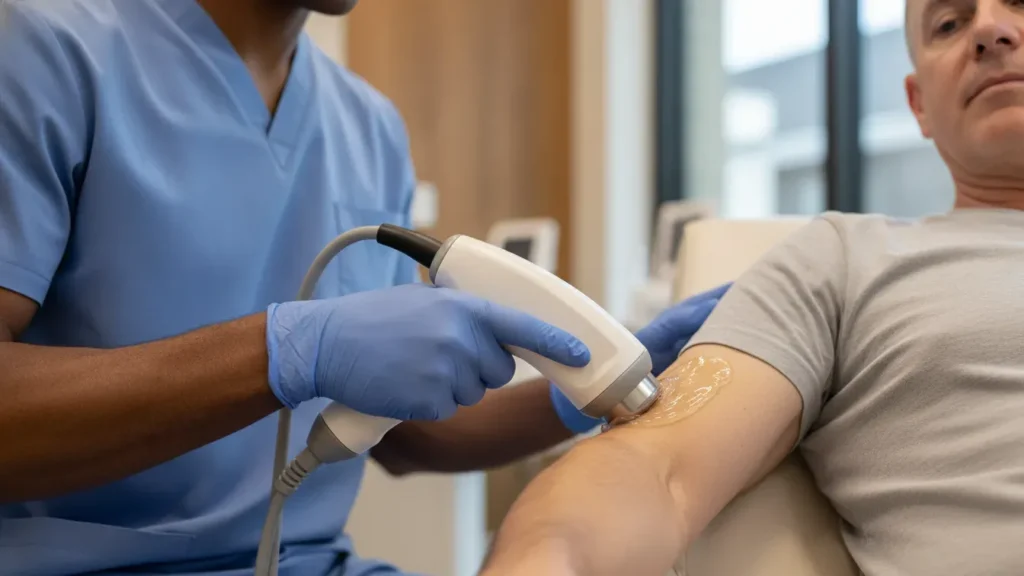
Tendon pain can affect movement, exercise, and everyday routines, but the source of that pain is not always obvious. If you are researching shockwave therapy for tendon pain, start with an informed evaluation rather than assuming one treatment fits every tendon condition.
Request an appointment to discuss your questions
Shockwave therapy for tendon pain is an option a qualified clinician may discuss after considering the affected tendon, symptom history, prior care, goals, and alternatives. Research findings and treatment protocols vary. Premier Wellness Florida’s current availability and protocol should be confirmed directly with the clinic.
A thoughtful discussion can clarify whether the symptoms fit a tendon problem, what questions to ask about the approach, and how other options may factor into the decision. Understanding the treatment is a practical place to begin.
What Does Shockwave Therapy for Tendon Pain Involve?
Shockwave therapy for tendon pain generally refers to the use of externally delivered sound-wave energy near a painful tendon or related tissue. The term “tendinopathy” is broad. It can describe tendon conditions associated with discomfort, restricted movement, or reduced function, rather than one single diagnosis. It may be discussed in connection with the elbow, heel, knee, shoulder, or wrist, among other areas. A clinician would need to evaluate the location, history, and pattern of symptoms before deciding what the pain may represent.
That distinction matters because tendon pain can have different causes and may overlap with problems involving nearby muscles, joints, nerves, or other structures. A general description of shockwave therapy cannot establish whether it is appropriate for a particular person. It also should not be read as a promise of pain relief, healing, tissue repair, or a specific recovery timeline.
What does the research actually examine?
A 2024 systematic review and meta-analysis evaluated 45 clinical studies involving extracorporeal shockwave therapy for different tendinopathies. The researchers searched available databases through March 2023 and assessed the quality of randomized trials using the Cochrane Risk of Bias 2 method. Those details help show that the topic has been studied, but they do not turn research findings across multiple conditions into a predicted result for an individual patient. Read the systematic review.
The studies included different tendon conditions, outcome measures, and comparison groups. As a result, evidence from one condition or protocol may not apply to another. The review itself called for additional high-quality research to clarify the best options for each type of tendinopathy. A separate lower-limb meta-analysis also noted ongoing questions about radial versus focused approaches and dosage. Review the lower-limb analysis.
Premier Wellness Florida’s public information does not confirm a current shockwave protocol or availability. Any discussion of this option should therefore remain educational and conditional, with treatment details addressed during an individualized clinical conversation.
Why Does the Diagnosis Matter Before Choosing Treatment?
Tendon pain is a symptom, not a diagnosis. Before discussing shockwave therapy for tendon pain or another option, a clinician needs to understand what you are experiencing and whether the painful area is actually the source of the problem. Similar symptoms can arise from different tissues or conditions, and the most appropriate next step may depend on details that are difficult to sort out from a general description alone.
What to discuss during an evaluation
Be prepared to describe where the discomfort is located, when it began, whether it followed an injury or developed gradually, and what activities make it better or worse. Walking, lifting, gripping, running, climbing stairs, or remaining in one position may reveal useful patterns. Also mention changes in strength or movement, previous care, medications, and any symptoms that seem unrelated at first. These details help frame a conversation without assuming that one treatment fits every person.
The broader context matters as well. Premier Wellness Florida describes its consultation process as considering a person’s history, lifestyle, and goals before options are discussed. Its intended audience includes adults dealing with joint pain, injuries, arthritis, or reduced mobility, but that description does not establish a diagnosis or confirm that a specific therapy is appropriate. A clinician may need to consider other causes, such as a nearby joint issue, nerve-related symptoms, referred discomfort, or an injury that needs a different kind of assessment.
If symptoms have persisted, the discussion may also benefit from understanding why tendon injuries can linger. Readers in Cape Coral and Southwest Florida can also review a joint and mobility consultation as a starting point for questions about history, goals, and available options.
That evaluation does not guarantee candidacy, availability, or an outcome. It creates a more informed basis for deciding whether to discuss shockwave, another conservative approach, further assessment, or no procedure at all.
Who Might Discuss Shockwave Therapy With a Clinician?
A person with persistent tendon symptoms may reasonably ask a clinician whether shockwave therapy for tendon pain belongs in the conversation. Mayo Clinic describes shockwave as an option that may be considered for chronic tendinopathy or symptoms that have not responded to previous treatments. That description is a prompt for evaluation, not a statement that the treatment is appropriate for everyone.
The first question is what is causing the discomfort. Tendon pain can occur in areas such as the elbow, heel, knee, shoulder, or wrist, and similar symptoms may have other explanations. A clinician may need to review how the symptoms began, what activities aggravate them, how they affect movement, and what care has already been tried. A history of prior treatment does not establish candidacy, and a chronic symptom does not by itself identify the right next step.
This discussion may be especially relevant for active adults who want to keep walking, exercising, working, or participating in hobbies while addressing an ongoing mobility concern. However, an interest in staying active is not an eligibility determination. The useful goal is a candid conversation about the diagnosis, available options, tradeoffs, and realistic expectations. Readers can review mobility support for active adults for broader context, without assuming that any particular service will be recommended.
Premier Wellness Florida’s public materials do not confirm current shockwave availability or a Premier-specific protocol. They also do not establish treatment-specific safety, efficacy, authorization, or eligibility. If you contact the clinic, ask whether shockwave is currently offered, who evaluates potential candidates, what alternatives may be considered, and what clinical information is needed before discussing it further.
Which Protocol Questions Should You Ask?
A useful conversation focuses on how a clinician would individualize the plan, rather than assuming every case follows the same schedule. You can ask:
- How many sessions would you consider, and how far apart would they be? An international Delphi panel reached consensus around three to five sessions spaced one to two weeks apart, while Mayo Clinic describes weekly sessions for three to five weeks. Those references describe published recommendations and one clinical setting, not a schedule that is automatically right for you. Read the Delphi recommendations and compare them with Mayo’s patient explanation.
- What energy level and intensity would you start with? The panel favored low-to-medium energy for tendon conditions and recommended beginning at a low, tolerable level, then adjusting as tolerance changes. Ask how the clinician would monitor your response and whether the intensity can be modified during a session.
- How would you identify and target the treatment area? The panel recommended clinical focusing over imaging guidance for tendon conditions, defining the focus around the area of greatest pain reported by the patient. That recommendation still requires a clinician to determine whether the painful area matches the suspected tendon problem.
- Which probe or shockwave type would you use, and why? The Delphi panel suggested combining radial and focused probes when available, but a lower-limb meta-analysis found that differences between shockwave types and dose remain controversial. Ask what equipment is available and what the choice is intended to address.
- How many shocks would be delivered? The expert panel did not reach consensus on an average number for tendon treatment, even though 2,000 was the most common response. A number should not be treated as a universal target.
- What should I expect for discomfort and anesthesia? Ask how pain tolerance will guide adjustments. The panel did not recommend local anesthesia during treatment, but that is an expert-panel statement, not personal medical advice. Mayo describes treatment lasting about five to fifteen minutes, with intensity adjustable by the physical therapist.
- How would exercise or rehabilitation fit with the plan? The panel recommended considering physical therapy exercises alongside shockwave for tendon and joint pathology. Ask whether exercise pairing is appropriate for your assessment, activity level, and goals, rather than assuming it belongs in every plan.
Is Shockwave Therapy Painful or Dangerous?
Discomfort is a reasonable question when you are considering shockwave therapy for tendon pain. The experience can vary with the body area, the condition being evaluated, the treatment settings, and your individual tolerance. A clinician should explain what sensations to expect and how the intensity can be adjusted rather than presenting the procedure as painless or appropriate for everyone.
A Mayo Clinic Sports Medicine article lists possible side effects including mild bruising, swelling, pain, and numbness or tingling in the treated area. These possibilities do not establish how likely or serious a reaction will be for a particular person. Ask what symptoms are expected briefly after treatment, which ones should prompt a call, and who you should contact if symptoms persist, worsen, or concern you. Read the Mayo Clinic discussion of possible side effects.
How is discomfort handled?
An international expert panel recommended beginning at a low, tolerable energy level and increasing it according to the patient’s tolerance. For tendon conditions, the panel recommended keeping treatment pain below a specified threshold, and it did not recommend local anesthesia during treatment. These are expert-panel recommendations, not individual medical advice or a guarantee about your experience. Bring useful questions to a qualified clinician: What settings would you consider? How will you monitor my response? What is the plan if the sensation is not tolerable?
What should you review before deciding?
Discuss your diagnosis, medical history, medications, skin or nerve symptoms, prior procedures, and any factors that could change the risk discussion. Also ask what evidence applies to your specific tendon problem. A 2024 systematic review called for more high-quality research to clarify the best treatment choices for each type of tendinopathy. So published evidence should not be treated as a promise of safety or results for you. If you are exploring this option in Southwest Florida, an individualized evaluation can help separate general information from a recommendation based on your circumstances.
How Does Shockwave Compare With Other Options?
Choosing among options for tendon pain is less about finding a universal winner and more about matching the discussion to the diagnosis, symptoms, activity demands, prior care, and personal goals. Research on shockwave includes several different tendon conditions, including plantar fasciitis, Achilles, elbow, rotator cuff, and patellar tendinopathy. The studies also used varied pain measures and comparison groups, so results should not be transferred automatically from one tendon problem to another. A systematic review called for more high-quality research to clarify choices for each type of tendinopathy.
Decision factors to discuss when comparing tendon-pain options
| Option or discussion area | What it may involve | What to clarify with a clinician |
|---|---|---|
| Shockwave discussion | A device-based approach whose type, dose, targeting, and schedule may vary. A lower-limb meta-analysis of 29 randomized trials noted ongoing controversy around radial versus focused approaches and dose. | Which tendon condition is being addressed, what evidence applies to it, what device and settings are proposed, and what limitations or alternatives should be considered? |
| Exercise or physical therapy | Progressive, condition-specific exercises and movement coaching may be considered as part of an individualized plan. An international Delphi panel recommended considering physical therapy exercises alongside shockwave for tendon and joint pathology. | Which movements, strength goals, frequency, and progression fit the assessment? How should activity be adjusted if symptoms change? |
| Load or activity modification | Temporarily changing training volume, repetitive tasks, footwear, or other stressors may be discussed while the tendon concern is evaluated. | Which activities can continue, which should be modified, and how will a gradual return be guided without assuming a specific recovery timeline? |
| Other individualized options | Depending on the clinical assessment, a discussion may include observation, rehabilitation adjustments, or options such as questions about PRP therapy and regenerative medicine options for joint pain. | What problem is each option intended to address, what evidence supports it for this condition, what uncertainties apply, and what follow-up would be needed? |
These categories can overlap rather than represent mutually exclusive choices. The Delphi recommendations are expert consensus, not a guarantee of benefit for an individual. Likewise, the lower-limb review reported that shockwave type and dose may contribute differently to study outcomes. A clinician can help weigh those uncertainties alongside examination findings and your priorities, without presenting one option as automatically superior.
What Should You Expect From a Consultation?
A consultation should begin with your story, not with a predetermined procedure. The clinician may ask when the discomfort began, what activities affect it, what evaluations or treatments you have already tried, and how the problem affects your daily life. Premier Wellness Florida describes reviewing your history, lifestyle, and goals before discussing possible options. That process can help separate a tendon concern from other causes of pain and clarify which questions need further evaluation.
Bring a list of symptoms, relevant medical records, imaging reports, medications, and any previous treatment details you have available. You can also ask how the working diagnosis was reached, what evidence supports a proposed option, what alternatives exist, and how progress would be assessed. If you are asking about shockwave therapy for tendon pain, ask whether it is currently available and who would provide it. You can also ask what protocol would be used and whether the clinician considers it appropriate for your situation. Availability and clinic-specific protocol should be confirmed directly, rather than assumed from general information online.
The public services information does not establish current shockwave availability or a Premier-specific protocol. A discussion can still help you understand your choices without creating an expectation that a particular treatment will be offered or produce a particular result. For a broader conversation about your history and goals, you can learn about a joint and mobility consultation. You may also contact the clinic with questions before requesting an appointment.
Request an appointment to discuss your questions
Frequently Asked Questions
Is shockwave therapy effective for tendon pain?
Research findings vary by tendon condition, treatment approach, comparison group, and outcome measure. A 2024 review included 45 studies and called for more high-quality research to clarify the best options for each tendinopathy. That means effectiveness should be discussed as an evidence question, not assumed from the treatment name or from another person’s experience. Read the review.
Is shockwave therapy painful or dangerous?
Sensation and tolerance can vary. Mayo Clinic notes that possible side effects may include mild bruising, swelling, pain, or numbness and tingling. Ask a qualified clinician how discomfort would be monitored, which symptoms should be reported, and whether your medical history changes the discussion. These questions are more useful than treating the procedure as universally safe or unsafe. Mayo Clinic outlines these considerations.
How much does shockwave therapy for tendonitis cost?
There is no reliable universal price. Cost can depend on the diagnosis, number of visits, equipment, clinician, and whether the service is covered or self-pay. Ask for the current fee, what each visit includes, and whether an evaluation is billed separately. Premier Wellness Florida’s current shockwave availability and pricing should be confirmed directly before you make plans.
Can shockwave therapy help Achilles or peroneal tendinopathy?
Those conditions require different anatomical and clinical questions, so a treatment should not be selected from a body-part label alone. Ask how the diagnosis was established, whether the tendon problem is acute or persistent, what alternatives are reasonable, and how the potential tradeoffs apply to your goals. A consultation can help clarify whether shockwave belongs in the discussion at all.
Ready to Discuss Your Tendon Pain?
A thoughtful conversation can help you organize your symptoms, goals, and questions before considering any treatment option. Premier Wellness Florida can review your concerns and discuss whether an evaluation is an appropriate next step. Request an appointment online, and staff will confirm availability by phone.