
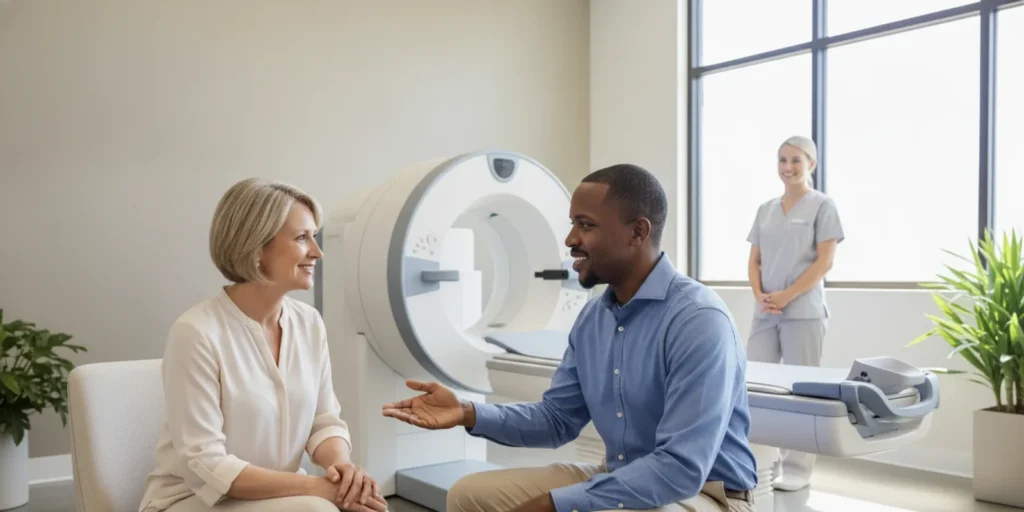
What is a DEXA scan, and what should you ask before arranging one? A DEXA scan is an imaging test that uses low-dose X-rays to measure bone mineral density; some facilities also use the technology to estimate body composition. The reason for the scan affects what it measures, how it is ordered, and what you should check about the cost.
Contact the clinic with your questions
What is a DEXA scan?
DEXA is short for dual-energy X-ray absorptiometry. You may also see it written as DXA. The scanner sends two low-dose X-ray beams through the body, and a computer uses the difference in how the beams are absorbed to produce measurements. A scan is usually performed while you lie on a table as the scanner moves over the area being assessed. It is not the same as a regular X-ray, and it does not involve an injection.
In a bone-density exam, the scan commonly measures specific areas such as the lower spine and hip. A clinician may use the results, along with your history and other information, to assess bone health and decide whether further evaluation or care is appropriate. The scan is one part of that decision; it does not explain every cause of pain, establish a diagnosis on its own, or predict exactly what will happen to an individual.
DEXA equipment may also be used for a different purpose: estimating body composition, such as the distribution of fat and lean tissue. This is not interchangeable with a bone-density test. Before you book, confirm which type of exam is being offered and what question it is intended to answer. For general patient information about imaging, you can also consult RadiologyInfo, a resource from the American College of Radiology and the Radiological Society of North America.
Why might a clinician recommend a DEXA scan?
A bone-density DEXA may be considered when a clinician wants more information about bone strength or fracture risk. Whether it is appropriate depends on the person’s age, health history, prior fractures, medications, other risk factors, and applicable screening guidance. Recommendations can differ by individual and by clinical organization, so do not use a general online checklist to decide that you need a scan.
A clinician may also request testing to establish a starting point or to monitor bone density over time. If you have an earlier scan, the date and facility may matter when a clinician considers whether another test is useful. Ask whether the new examination should be compared with earlier images or measurements and whether the same facility or equipment is preferred.
The interval between scans should be based on the clinical question, prior results, and the clinician’s judgment—not on a general schedule found in an advertisement. Repeating a test too soon may not answer a useful new question. If a repeat is suggested, ask what has changed since the last exam, what the clinician hopes to learn, and how the result could affect the next decision. If you have moved or changed facilities, request the earlier report and ask whether the images themselves are needed for comparison.
A DEXA scan also has limits. It measures bone density at selected sites, but it does not directly show every aspect of bone quality or explain all symptoms. A normal result does not automatically rule out every bone or joint problem, and an abnormal measurement does not by itself specify the cause or best response. Share your full health history and questions with the clinician interpreting the result, especially if you have new symptoms or a prior fracture.
Some people hear about DEXA through a fitness or body-composition program. That use has a different purpose from assessing bone density. Ask what the results can and cannot tell you, how they will be interpreted, and whether the measurement will change a health decision. A number without context may be less useful than a discussion of your goals and medical history.
If you are exploring care for joint or mobility concerns, separate that conversation from the question of bone-density testing. A DEXA scan does not evaluate every joint problem, and having a scan does not establish which treatment is suitable. Premier Wellness Florida’s services overview describes clinic offerings; confirm directly whether any specific test is available before planning around it.
How does a bone-density scan differ from a body-composition scan?
The same broad technology may be used in exams with different purposes, analysis, and billing. Ask the ordering clinician and facility to name the exact exam rather than relying on the general term “DEXA.” The table below is a planning guide, not a substitute for the facility’s description of its service.
| Question | Bone-density DEXA | Body-composition DEXA |
|---|---|---|
| Main purpose | Measures bone mineral density at selected sites to inform a bone-health assessment. | Estimates body composition, often including fat and lean tissue distribution. |
| Who may request it | A clinician may request it when bone-health information is relevant to an evaluation or monitoring plan. | A facility or program may offer it for fitness or composition tracking; ask what professional interpretation is included. |
| What to clarify | Which body areas will be measured, who interprets the results, and how the findings fit your history. | What measurements are reported, what they mean, and whether the service is diagnostic or intended for tracking. |
| Cost questions | Ask about the exam charge, interpretation, facility billing, and possible insurance processing. | Ask whether it is self-pay, what the quoted fee includes, and whether a separate consultation or report costs extra. |
What can change the cost of a DEXA scan?
There is no single price that applies to every DEXA scan. The total may depend on the type of exam, the facility, the region, the reason for testing, and how the service is billed. A quote for a body-composition assessment may not be comparable to a quote for a bone-density exam ordered as part of clinical care.
- The purpose and scope of the exam: Confirm whether it is a bone-density study or a body-composition scan, which areas are included, and whether any additional imaging or measurements are planned.
- Where the scan is performed: A hospital outpatient department, imaging center, or other facility may use a different billing structure. Ask whether the quoted amount is the facility charge, the interpreting clinician’s fee, or a combined estimate.
- How the scan is ordered and billed: If a clinician orders a diagnostic exam, the facility may submit a claim to an insurer. Coverage, eligibility, deductibles, copays, and authorization rules are plan-specific. Do not assume that a scan is covered or that an online estimate is your final responsibility.
- Whether the estimate includes interpretation: Ask if a qualified professional’s interpretation and report are included, or if they appear as separate charges.
- Your insurance and billing details: Confirm the facility’s participation status and the plan’s rules directly with both the facility and insurer. A network statement alone may not answer whether this particular service is covered under your benefits.
- Follow-up services: Find out whether a result-review appointment is included or billed separately. Ask who will explain the findings and how the report will reach the clinician who requested the scan.
- Repeat or comparison studies: If you have a previous exam, ask whether obtaining those records could help the clinician decide what testing is appropriate. Do not schedule repeat scans simply because a facility offers them.
When comparing prices, request a written estimate for the same type of exam and the same services. One facility might quote only the scan, while another includes interpretation or a follow-up discussion. Comparing unlike packages can make a lower headline amount misleading.
It may help to write down the estimate details while you call. Record the facility name, exam description, whether a clinician’s order is needed, the amount due at the visit, and any separate professional or facility fees. If insurance is involved, note the representative’s name or reference number, the date you checked, and the exact wording of the coverage explanation. This is not a guarantee that a claim will be paid, but it gives you a clearer record to revisit if the final bill differs from the estimate.
Ask whether the quote changes if the scan is repeated or if additional views are requested. Do not assume that every extra measurement will be included in the initial price. If you are paying directly, ask whether the facility has a self-pay rate and what happens if you cancel or reschedule. If you are using insurance, ask whether the estimate is based on your current deductible and whether separate claims could come from the facility and the interpreting professional. You can then compare the likely total rather than just the most visible fee.
What should you ask before you book?
A short call can clear up whether the proposed exam fits the question you are trying to answer. If a clinician recommended a scan, keep the referral or order available and ask the office to clarify anything you do not understand. If you are considering a self-pay body-composition scan, ask what the results are meant to support and whether there is an additional charge for interpretation.
- What exact DEXA exam is this? Ask whether it is for bone density or body composition, what areas it covers, and whether it is being ordered by a clinician.
- What is the reason for the test in my case? Ask what decision the result may inform and whether there are alternatives or reasons to wait. The person ordering the exam can explain its role in your care.
- What will I owe? Request an itemized estimate that distinguishes the scan, interpretation, facility charge, and any follow-up. If using insurance, check the plan’s estimate and authorization requirements as well as the facility’s.
- Who will review and explain the result? Confirm whether the report goes to the ordering clinician, when it is expected, and whom to contact with questions.
- What preparation is needed? Ask the facility about its own instructions. Tell the staff if you may be pregnant, recently had imaging that involved contrast material, or have other circumstances they ask about. Follow the facility’s guidance rather than assuming preparation is identical everywhere.
- Can previous records be used? Ask whether the clinician wants earlier reports or images, and how to send them securely before the appointment.
- What happens if the test is not covered? Ask for the self-pay amount, cancellation policy, and whether you can pause while you check benefits or discuss the plan with the ordering clinician.
For a broader discussion of bone-health terms, Premier’s educational guide to osteopenia and osteoporosis may be a helpful starting point. It is not a personal interpretation of a DEXA result. Bring questions about your own report to the clinician responsible for your care.
What happens during and after the scan?
For a typical bone-density scan, you lie still on a padded table while the scanner moves above you. The technologist may position your legs or ask you to change position so the required area can be measured. The scan itself does not usually require a needle or medication. The facility should explain its process, expected appointment length, and any preparation instructions when you schedule.
Afterward, a report is prepared for the clinician who ordered the test or the professional responsible for interpreting it. Do not try to compare numbers from different exam types as though they are the same measurement. The meaning depends on the scan method, the areas measured, the person’s age and history, and the clinical question. Ask the ordering clinician to explain any terms, limitations, or recommended next steps.
If a result raises a concern, that does not automatically dictate one treatment. A clinician may consider additional history, other tests, medications, fall risk, nutrition, activity, and individual preferences. Decisions involving medication or a procedure should be made with a qualified clinician who can discuss possible benefits, risks, alternatives, and the consequences of delaying or declining care.
How can you plan the next step without assuming the answer?
Start with the question you want answered: Are you checking bone density because a clinician recommended it, comparing a self-pay body-composition service, or trying to understand an existing report? Then confirm the exam type, the professional responsible for interpreting it, and the complete price. If the scan is being considered because of symptoms, a prior fracture, or a health condition, ask the clinician whether it is the right test rather than treating a scan as a general checkup.
Premier Wellness Florida is a regenerative medicine and wellness clinic, and the online new-patient information and wellness-planning page offer context about the clinic. These pages do not establish that DEXA testing is available there. If you are trying to arrange a scan, ask the clinic directly whether it offers the specific exam or can clarify the appropriate route to an imaging provider.
If your next step is a conversation with the clinic about its services, you can review its appointment request information or consultation details. A request is not a confirmed appointment; staff confirm availability by phone. You may also use the contact page to ask whether the clinic can address your question. For questions about an imaging location, check directly with the facility you plan to use; a clinic’s locations page is not confirmation that it performs scans.
Ask the clinic about your next step
Frequently asked questions
Is a DEXA scan the same as an ordinary X-ray?
No. DEXA uses low-dose X-rays to produce measurements for a specific purpose, such as bone-density assessment or body-composition estimation. It is not a general X-ray of every bone or joint. Confirm the exact exam being offered and what it is intended to measure.
Does a DEXA scan diagnose osteoporosis?
A bone-density scan provides measurements that a clinician may use when assessing bone health. A diagnosis and care plan require interpretation in context, including relevant medical history and other findings. Ask the clinician who ordered the scan to explain what your individual report means.
Does insurance cover a DEXA scan?
Coverage varies with the plan, the reason for the test, the facility, and applicable requirements such as authorization or cost sharing. Ask the insurer and imaging facility about the specific exam and request an estimate before booking. Do not treat a general coverage statement as confirmation of your own benefits.
Can I book a DEXA scan without a clinician?
Some facilities may offer self-pay body-composition scans, while a diagnostic bone-density exam may involve an order or other clinical requirements. Policies vary. Ask the facility what it requires and whether the result will be interpreted by a qualified professional.
How do I compare two DEXA scan quotes?
Check that both quotes are for the same type and scope of exam. Compare the scan fee, interpretation, facility charges, follow-up, and insurance assumptions. Ask for any exclusions in writing so you understand the likely total rather than only the advertised starting price.
A DEXA scan is useful only when the exam matches a clear question and its results will be interpreted in context. Confirm the purpose, full cost, and follow-up plan with the facility and clinician before deciding whether to proceed.